|6 min read
Salt Air Is the Whole Problem
Christmas lights that hold up fine in Phoenix fall apart in La Jolla. Not because of cold. Because of salt.
Marine air carries salt, and salt is corrosive. It settles into the socket where the bulb base meets the metal contact and it starts working. You never see that part. What you see is a strand that lit up perfectly on install day, has three dead bulbs by December 10th, and goes dark in a whole section a week later.
UV does the rest. The San Diego sun sits on that wire every daylight hour of the season. Cheap PVC insulation chalks, stiffens, and starts to crack. Then the first Santa Ana comes through at 40 miles an hour and finds every weak point you didn't know you had.
Wind is the third one, and it comes from both directions here. Onshore breeze is basically constant on the coast. Santa Anas run the other way, hot and dry and hard. A display clipped correctly rides out both. A display that's stapled or taped does not.
Which Areas Take the Worst of It
Exposure is not even across San Diego. As far as your lights are concerned, a house in Scripps Ranch and a house on the La Jolla bluff are in two different climates.
The hardest exposure is oceanfront La Jolla, especially anything with a clear line to the water and nothing in front of it. Del Mar's beachside blocks are the same story. Coronado gets it from both sides, ocean and bay. Sunset Cliffs is the roughest of the four, because it's salt spray plus steady wind with zero shelter.
Move a mile inland and it changes fast. Carmel Valley, Poway, Rancho Bernardo, Scripps Ranch. Still plenty of sun and still Santa Anas, but the salt load drops off hard.
We don't spec differently for it or charge differently for it. The same commercial-grade hardware goes on every house, because the version that survives Sunset Cliffs survives everywhere else without thinking about it.
What We Install Instead
Four things separate a display that runs clean all season from one you end up calling somebody about.
- Commercial-grade C9 LEDs. Heavier bulb, a real base, rated for outdoor use across multiple seasons instead of one.
- Weather-sealed sockets. The seal is what keeps salt air off the contact. On a coastal roof it's the single most important part on the strand.
- UV-stabilized wire. Rated to sit in direct sun for months without going brittle.
- Clips cut to your roofline. Sized to your gutter lip or shingle edge and spaced to hold in wind.
The Part Nobody Thinks About: Connections
Bulbs get all the attention. Connections are where coastal displays actually die.
Every plug junction outdoors is somewhere moisture can sit, and out here it's moisture with salt in it. We keep junctions up off the ground, wrap them, and run a drip loop so water runs away from the plug instead of down into it. Power comes off a GFCI outlet. The smart timer lives somewhere covered, not zip-tied to a downspout where it fills with water in the first December rain.
That's maybe ten extra minutes per house. It's also most of the difference between a display that runs 60 nights without a service call and one that doesn't.
C9, Mini Lights, or Icicles
Three options come up on nearly every design. Here's the honest version of when each one is right.
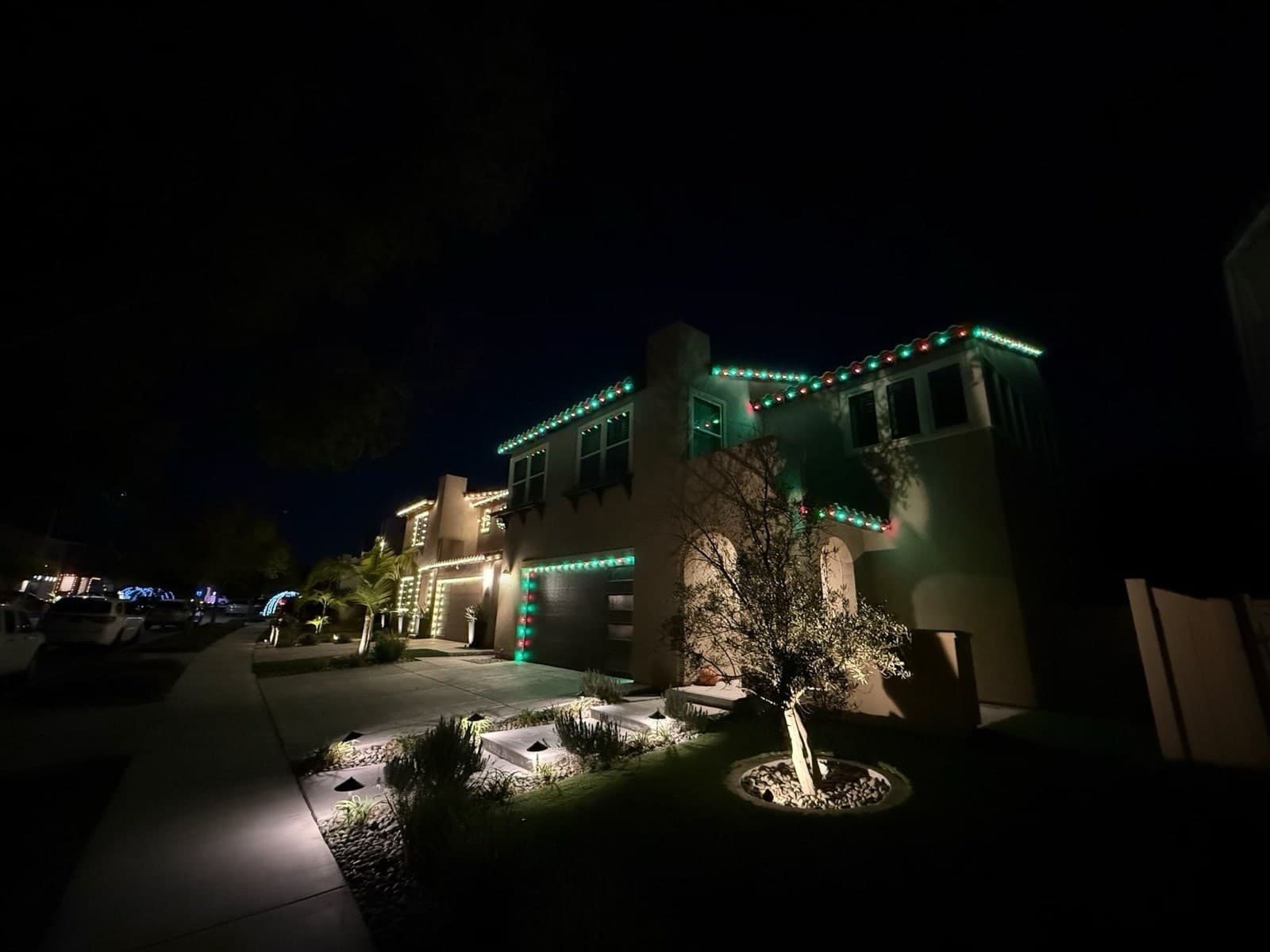
C9 is the standard for rooflines and it's what we put on most homes. The bulb is big enough to read as a distinct point of light from the street, which is what makes a house look outlined rather than vaguely glowing. On a two-story, or on any home set back from the road, it isn't close. C9 wins.
Mini lights belong on trees and shrubs, not on rooflines. Wrapped around a trunk or worked through branches they read as texture, which is exactly what you want there. Strung along a roof edge and viewed from 80 feet away, they blur into a smudge of light.
Icicles are a look, not an upgrade. They hang from the roof edge in varied drops and give you a lot of movement, which works beautifully over a long straight run like a porch or a garage front. They're $10 a foot on either story, because there's more material per foot and hanging them so the drops stay even takes longer. On a busy roofline with a lot of peaks and dormers they can read as cluttered. On a simple horizontal front they look great.
A lot of homes end up with two of the three. C9 on the roofline, minis on the palms, icicles over the garage.
Twelve-Inch Spacing and Why Cheap Installers Stretch It
Standard bulb spacing on a front roofline is 12 inches. That's the number that makes a house read as evenly outlined from the curb.
Cheaper installers stretch it. Fifteen inches, eighteen, sometimes more. The reason is simple. Wider spacing means fewer bulbs and less wire per foot of roof, so the material cost drops and the hang goes faster. It's a quiet way to bring a bid in under somebody else's without changing anything you'd notice on paper.
You can see it from the street even if you can't name it. At 12 inches the roofline reads as one continuous line of light. At 18 it reads as a row of separate dots with dark gaps between them, and the gaps get more obvious the farther back you stand. On a home with any real setback from the road, stretched spacing is the difference between outlined and dotted.
So ask any installer what spacing they quote and get the number. If the answer is vague, that's your answer.
Warm White or Multi-Color on a Coastal Home
Color is taste, not engineering, so we don't push people either way. But coastal homes do have a pattern worth mentioning.
Warm white reads cleanest on light stucco, white trim, and the pale palettes that are everywhere from Del Mar to Coronado. It looks like architecture rather than decoration, and it photographs well against a dark ocean sky. It's what most of our La Jolla and Del Mar clients pick.
Multi-color C9 is the traditional look and it lands best on homes with darker trim, brick, or a lot of surrounding landscape to bounce off. On a bright white house it can look busier than people expect once it's actually lit.
Either way, the hardware underneath is identical. Same commercial-grade bulb, same sealed socket, same wire. Color doesn't change what survives the season, and it doesn't change your per-foot price.
Clips, Not Staples. No Tape, No Holes.
We never staple, never tape, and never drill. Every strand goes up on clips sized to your gutter lip or shingle edge, and every clip comes off in January without leaving a mark.
Staples are the ones that cause real damage. A staple through fascia leaves a hole, and on a coastal home a hole is where water and salt get into the wood. Walk past a house that's had stapled lights for a few seasons and you can read the whole history of it in the fascia board.
Tape fails a different way. It holds through October, then lets go on the first warm week, usually taking a strip of paint with it.
The clips cost us more and they take longer to set. They're also the reason a takedown is just a takedown, with nothing to patch and nothing to repaint in the spring.
Keep reading
- Our holiday lighting service
- See your own house lit up, free
- Full pricing and packages
- HOA Rules for Christmas Lights in San Diego: How to Light Your House Without a Violation Letter
- Permanent Christmas Lights vs. a Yearly Install in San Diego: The Three-Year Math
- Christmas Lights on a Tile Roof: How We Hang Them Without Cracking a Tile
- Warm White or Multicolor? How to Pick Christmas Light Colors for a Stucco House
- How Much Does Christmas Light Installation Cost in San Diego? (2026 Prices)
- When to Book Christmas Light Installation in San Diego
Areas we serve