|9 min read
The Short Answer
Yes, your HOA can regulate Christmas lights. In California that's settled, and nearly every association in San Diego does it. What almost none of them do is ban lights outright. The rules are about when the display goes up, when it comes down, what hours it runs, and how it attaches to the house.
So the job isn't arguing with the board. It's reading the rules, asking in writing, and hanging the lights in a way that gives the architectural committee nothing to object to. We do this every season in Rancho Santa Fe, Carmel Valley, and Coronado, and the same approach works on a condo in Solana Beach.
If you'd rather skip the reading, send us a daylight photo of your house and your association's lighting guideline page. The design comes back already inside the rules, with a written layout you can submit.
What HOA Lighting Rules Usually Cover
Every association writes its own rules, but the same handful of items shows up almost every time.
- Dates. A day the lights may go up, often tied to Thanksgiving, and a day they must be down, often in the first half of January. The takedown date is the one people miss.
- Hours. Lights off by a set time, commonly 10 or 11pm. A timer makes this automatic.
- No flashing, chasing, or strobing. Steady lights only, and sometimes a line about brightness.
- Colors. Most associations don't restrict color. The stricter ones prefer white or warm white.
- Placement. Roofline, eaves, trees, and entries are usually fine. Figures and inflatables are where the rules get specific.
- Inflatables. Often limited, sometimes banned outright.
- Fasteners. No screws, nails, or staples into stucco, tile, or trim. Nothing that leaves a hole in January.
- Wiring. No extension cords across walkways and no visible cord runs down a wall.
Two Documents Hold the Answer
The CC&Rs (covenants, conditions, and restrictions, the recorded rules every owner in the community agreed to) usually say only that exterior changes need approval. The architectural guidelines, or the rules and regulations, are where the holiday detail lives, down to the dates and the hours. Read both.
If the answer isn't there, ask the manager in writing and keep the reply. An email saying your display is approved is worth more than anything we can hang.
What California Law Says, in Plain Words
Homeowners associations in California run under the Davis-Stirling Common Interest Development Act, the part of the state Civil Code that governs how an association operates. It lets an association adopt rules about the use and appearance of the property, including exterior changes and decorations, and it requires those rules to be reasonable.
In practice, most associations treat holiday lights as temporary decorations with their own calendar rule, not as an exterior change that needs an architectural application. That's why the common rules are about dates and hours rather than drawings and approvals. A permanent system is different, and we get to that below.
The practical point for a homeowner: the rules are written down and they apply to every lot the same way, so what the house down the street did last year isn't a defense. If the rule says down by January 15, plan for January 15.
We hang lights. We're not lawyers, and nothing here is legal advice. A real dispute with your board is a question for an attorney who does HOA work. For everyone else, the association's own documents are the answer, and they're usually a page long.
Why the Way the Lights Go On Matters to a Board
Most HOA guides stop at the calendar. The architectural committee cares just as much about the part it will see in February: holes in the fascia, tape marks on the stucco, a cord stapled down a wall. The install method answers most of what a committee is actually checking.
- Clips, not fasteners. Every strand goes on clips sized to the gutter edge, the fascia, or the lip of the first row of tile. Nothing gets stapled, nailed, glued, or drilled, and every clip comes off in January without leaving a mark.
- Nothing on the stucco. Adhesive clips and tape hold through October and let go in the first warm week, usually with paint attached. The lights stay on the roofline and off the wall.
- Strands cut to the roofline. No doubled-back excess bunched at the corners and no run stretched to cover a gap. The line reads clean from the street, which is what a committee means by tasteful.
- Power routed properly. Junctions kept up off the ground and wrapped, power off a GFCI outlet, and the timer somewhere covered. No cords across a walkway.
- A smart timer set to the association's hours. On at dusk, off at whatever time the rules say, every night, without anyone remembering.
- January takedown, included. We come back on the scheduled date, remove every strand and clip, and store the display labeled to your address. The end date in the rules is never missed, because it's already on our calendar.
Rancho Santa Fe and the Art Jury
Rancho Santa Fe is the strictest example on our route, and the Covenant is the strictest part of it. Homes there answer to the Art Jury as well as to the association, and out here the approval matters as much as the design.
Our default look already lands close to where most Covenant homes want to be: warm white, nothing strobing, no cord runs stapled across stone, and takedown on the calendar the association expects. If your street is stricter than that, tell us and we design to it.
We ask about your guidelines up front, build the plan to fit them, and if the Art Jury or your HOA wants something submitted, we hand you a written layout to submit. Fairbanks Ranch, Cielo, The Bridges, and Del Rayo each have their own rules and their own gates. Send the guideline page and the gate details with your photo and the crew shows up with both in hand.
Carmel Valley and the Master-Planned Communities
Nearly every street in Carmel Valley sits under an association, and the same goes for Pacific Highlands Ranch, Torrey Hills, and Del Mar Mesa. These neighborhoods were planned as communities, so they come with an architectural committee, published guidelines, and a management company that sends the letters.
Most of them are reasonable about holiday lighting: tasteful displays, seasonal dates, nothing left up in February. That describes every display we hang. The common trip-up is the takedown date, because the guideline says gone by late January and the homeowner's ladder stays in the garage until a Saturday in February. January takedown is built into every package, so the display is gone before anyone on the board thinks about it.
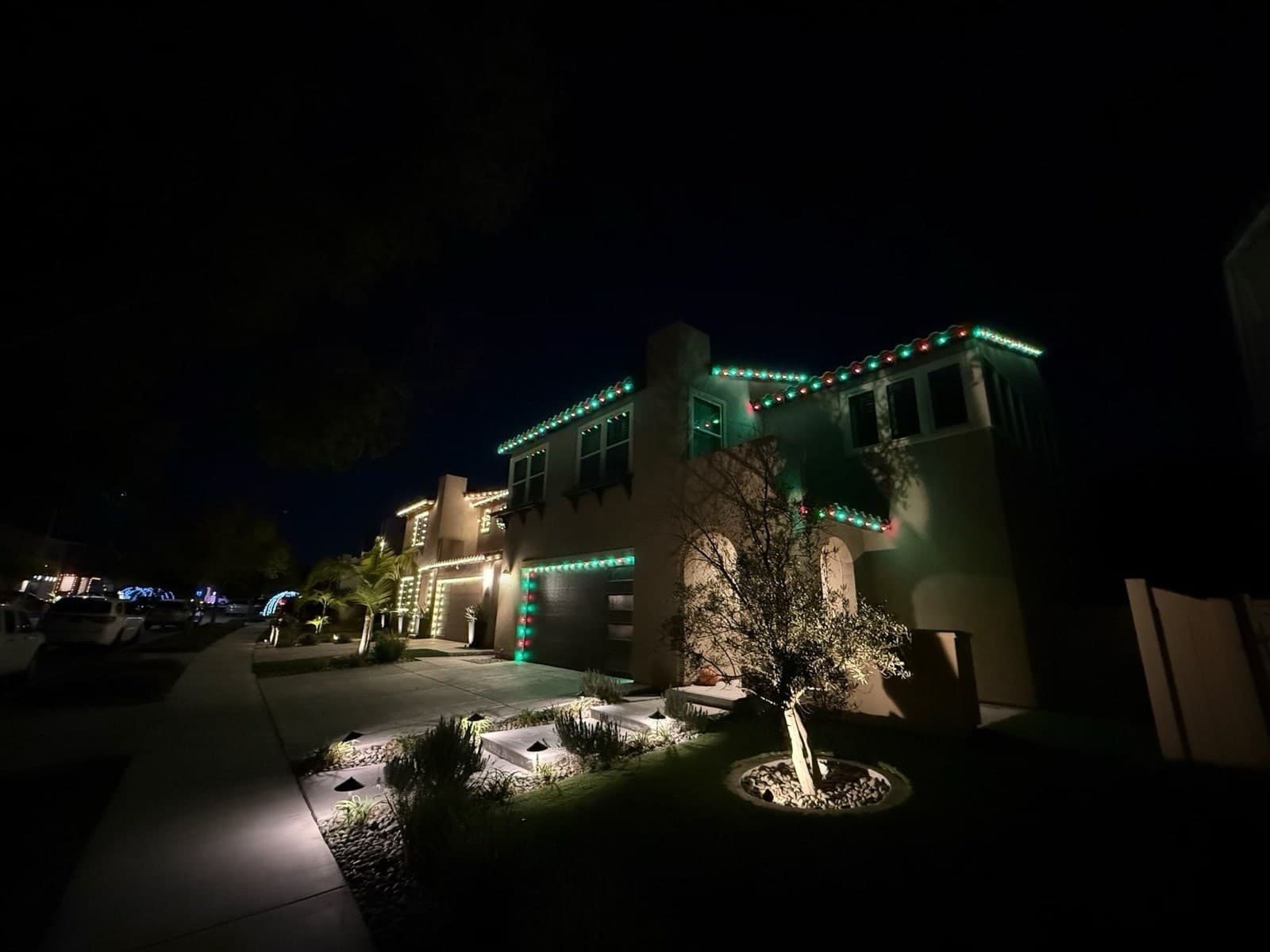
The houses here are mostly two-story stucco with tile eaves, which is its own subject. Clips fitted to the tile profile, nothing driven into the tile, and nothing on the stucco. We wrote a separate guide on tile roofs if that's your house.
Coronado, Condos, and Buildings Where the Owner Doesn't Control the Exterior
Coronado is a different kind of rule. The Village is mostly single-family homes on their own lots, and the rule that matters there is often the block's. Streets coordinate their displays, and the house that's off reads as off. Point at the house down the street and we match bulb type, spacing, and color temperature so your roofline reads as part of the block. The Cays and the Shores come with association rules of their own, so send the guidelines with the booking.
Condos and townhomes are the strictest case of all, because the building controls the exterior, not the owner. Whether your unit can have lights at all depends on your association. Some allow a balcony or a patio and nothing on the building. Some allow the roofline on a townhome row. Some allow nothing. That's as true of the bluff-top buildings in Solana Beach as it is of the bayfront buildings on Sail Bay in Pacific Beach.
The honest answer is to ask before you plan. If your association allows exterior holiday lighting on your unit, we can design inside whatever rules it sets. Send us the guideline page with your photo and we'll tell you straight away what works.
Permanent Lighting and HOAs
Permanent lighting changes the HOA question in two directions at once.
It's easier to live with, because there's nothing seasonal to police. The system is a custom-cut channel tucked under the fascia, color-matched to your trim so it disappears in daylight. From the street, most homeowners can't tell the lights are there when they're off. You run it from your phone: warm white as everyday accent lighting, holiday colors in December, off every other night. Associations that restrict seasonal displays are often more comfortable with that, because what they're reviewing is a trim-colored strip, not a December display. Often, not always.
It's also a permanent change to the exterior, so submit it like one. That means an architectural application in most associations, before anything goes on the house. We give you what the application needs: the channel color against your trim, where the run sits, a photo mock-up, and the note that color and schedule are set from the app, so a steady warm white on the association's hours is one setting. Permanent lighting starts at $35 per linear foot, and we design it from a photo the same way we design a holiday display.
What to Send the Association Before Install Day
Here's what an architectural committee or a manager usually wants, and what we hand you so you don't have to write it. Send it before install day, in writing, and keep the reply.
- A photo mock-up. Your own house with the lights on, from the Design Preview. It answers the question a paragraph can't.
- The dates. The install date and the takedown date, both inside the association's window.
- The hours. The timer schedule: on at dusk, off at the time the rules name.
- The mounting method. Clips on the gutter, fascia, or tile lip. No staples, nails, tape, adhesive, or holes. Every clip comes off without a mark.
- The hardware. Commercial-grade C9 LED bulbs, steady, in the color you're submitting.
- The insurance line. Coastal Clarity is fully insured and carries a City of San Diego business license, and we'll send a certificate of insurance before we set foot on your property if the association wants one on file.
See It on Your House First
The next step doubles as your application. Text one daylight photo of the front of your house to (858) 315-1247, and attach your association's lighting guideline page if you have it. We send the same photo back with the lights on and the price beside it, usually the same day.
The Design Preview is free, and nothing is due until you like what you see. If the committee asks for a change, send it along and we revise the layout. Changing a mock-up is easy. Changing a display after a violation letter is a second trip.
Keep reading
- Our holiday lighting service
- See your own house lit up, free
- Full pricing and packages
- Permanent Christmas Lights vs. a Yearly Install in San Diego: The Three-Year Math
- Christmas Lights on a Tile Roof: How We Hang Them Without Cracking a Tile
- Warm White or Multicolor? How to Pick Christmas Light Colors for a Stucco House
- How Much Does Christmas Light Installation Cost in San Diego? (2026 Prices)
- When to Book Christmas Light Installation in San Diego
- The Best Christmas Lights for Coastal San Diego Homes
Areas we serve