|Updated |6 min read
The Short Answer
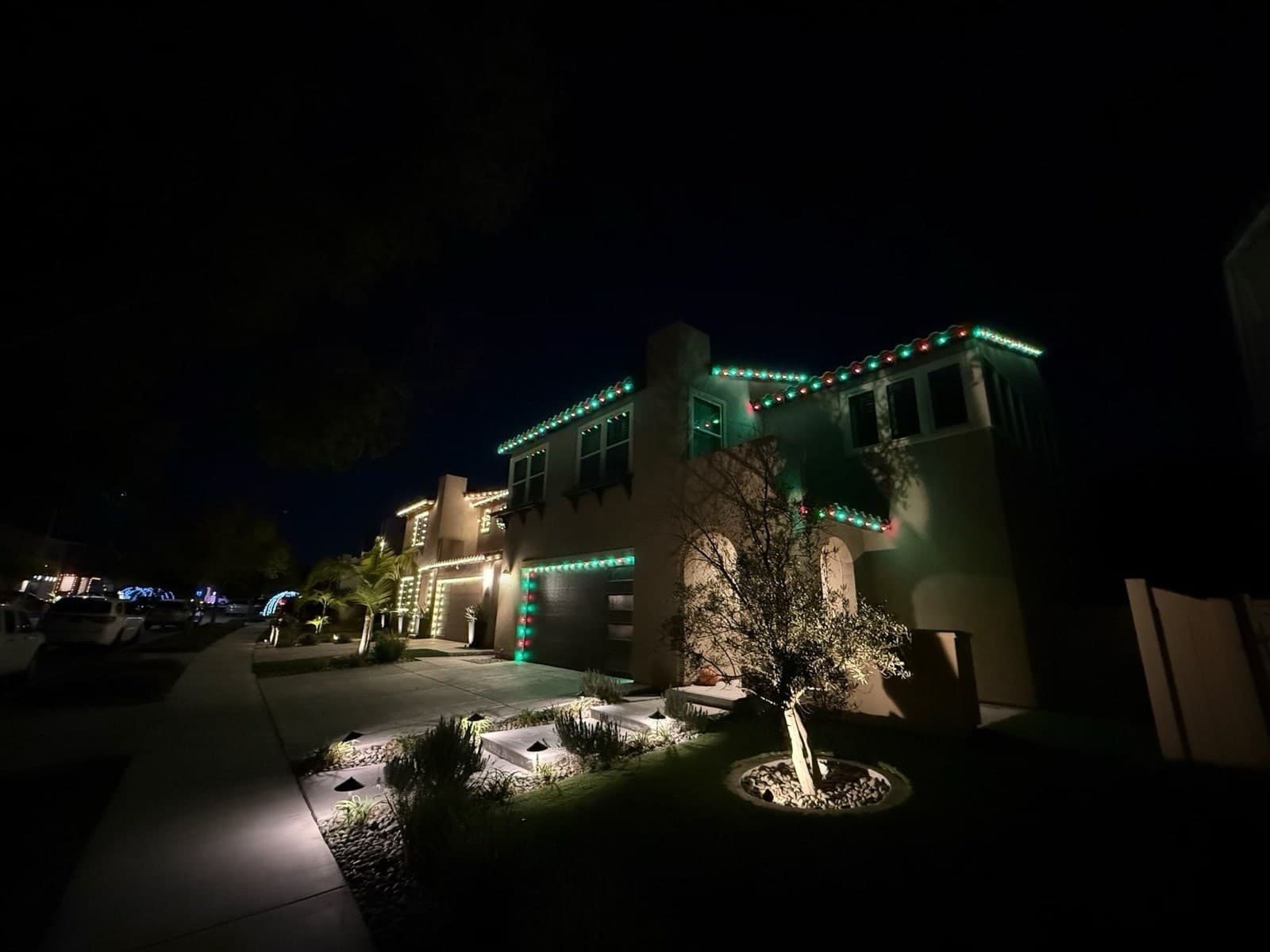
On most San Diego stucco, warm white on the roofline is the safe pick. It flatters cream, tan, and white walls, it looks right next to a tile roof, and nobody ever regrets it in the second week of December.
Color is taste, so we don't push anyone either way. Multicolor is the traditional look, and it lands best on a simple roofline with darker trim or plenty of landscape around it. Cool white is the hardest one to get right on warm stucco, with one exception below.
The better answer is that you don't have to guess. Send us a daylight photo of your house and we'll send back a mock-up of it with the lights on. If you're torn between looks, say so. We'll mock up as many Christmas color options as you want on the same photo.
Why Stucco Changes the Question
On a wood-sided house in a cold-weather town, Christmas lights are a line of dots against a dark wall. The wall mostly disappears at night and the color of the bulbs is the whole story.
Stucco doesn't disappear. It's a big, flat, pale surface, and it reflects. Every bulb on the fascia throws a soft wash of its own color down the wall under it. So on a stucco house you aren't only picking the color of the lights. You're picking the color your house turns for six weeks.
That's why the same strand can look warm and expensive on one house and a little cold and blue on the one next door. The bulbs didn't change. The wall did.
Warm White vs. Cool White
Warm white is the color of an old incandescent bulb or a candle. It has a little gold in it. Cool white is closer to daylight or a phone screen, and at night it reads slightly blue.
Most stucco in San Diego is some version of warm: cream, sand, tan, a soft off-white. Put warm white on it and the wall glows the way it does at sunset. Put cool white on it and the blue in the light fights the yellow in the paint. The wall goes a flat gray and the house looks colder than the night actually is.
Cool white has a real home. It can look sharp on a bright white modern house with black or charcoal trim, where everything is already crisp and there's no warm paint for it to argue with. It's also the classic look in places that get snow, because it matches the snow. We don't get snow. If you love the icy look, a mock-up will tell you in one picture whether your house can carry it.
One rule either way: never mix the two whites on one house. A warm roofline with a cool white tree next to it looks like a mistake from the street, even to people who couldn't tell you why.
When Multicolor Is the Right Call
Multicolor C9 bulbs are the look most of us grew up with, and if there are kids in the house, that usually settles it. It's cheerful and it says Christmas from two blocks away.
It works best where each color has room to read and something to stand against. A single clean roofline with darker trim is ideal, and brick or a lot of surrounding landscape helps too. On a bright white house it can look busier than people expect once it's actually lit, because the wall picks up a little of every color.
It gets harder on busy architecture. A Spanish-style house with four roof levels, arches, and a turret already has a lot going on. Trace all of that in five colors and it can tip from festive into noisy. On those houses we'd suggest one idea per house: multicolor on the main roofline and warm white on the trees and the entry, or warm white everywhere with garland and red bows doing the color.
Red and white is the third option people forget. Alternating red and warm white reads clean and a little more dressed up than full multicolor.
Look at the Roof and the Trim, Not Just the Wall
The wall is the biggest surface, but it isn't the only one the lights touch.
- Red clay tile: warm white along the eave makes the tile glow. It's one of the best-looking combinations in San Diego and it's hard to get wrong.
- Dark bronze or black trim: bulbs pop harder against it, so the roofline reads as a sharper line. Warm white looks rich. Multicolor looks bold.
- White trim on white stucco, the coastal look: everything reflects, so a little light goes a long way. Warm white keeps it soft. Multicolor can read busier than you expect here, so look at it in a mock-up first.
- Palms and olive trees: wrapped trunks almost always look best in warm white, whatever is on the roof. A multicolor trunk next to a multicolor roofline is a lot.
See It on Your Own House First
This is the part that makes the rest of the article optional. We build a Design Preview of your actual house before you pay anything: you send one daylight photo from the street, and we send the same photo back with the lights on, usually the same day.
If you can't decide between warm white and multicolor, tell us when you send the photo. We'll show you both on the same photo, and red and white too if you want it. As long as it's a Christmas color, ask. Same for the palms wrapped or left alone. Changing a mock-up is easy. Changing a roofline in December takes a crew.
There's a real example on our Design Preview page. A white two-story cottage in La Jolla, photographed in daylight by the homeowner. The preview we sent back showed warm white C9 bulbs on every roofline, garland with red bows over the front window, and a wreath on the door. The install-night photo next to it is the same house, and it matches. The family added the sleigh on the roof after seeing it.
Nothing is due until you've seen your house and you like it.
Color Doesn't Change the Price
Warm white, multicolor, red and white: the rate is the same. Roofline C9 lighting starts at $8 a linear foot, with an $800 minimum, and most homes land at $1,200 to $2,400 all-in once you add a tree or some garland. The lights are ours, so there's no separate bill for bulbs in the color you picked.
Two Coastal Notes
Near the water, the marine layer does something nice to warm white. On a foggy December night the haze catches the light and the whole roofline gets a soft halo. Cool white in fog tends to look like a parking lot.
And whatever color you choose, the color is the easy part on the coast. Salt air is what kills lights out here, which is why every strand we hang has sealed sockets and commercial-grade bulbs. We wrote a separate guide on that if you're close to the beach.
Keep reading
- Our holiday lighting service
- See your own house lit up, free
- Full pricing and packages
- HOA Rules for Christmas Lights in San Diego: How to Light Your House Without a Violation Letter
- Permanent Christmas Lights vs. a Yearly Install in San Diego: The Three-Year Math
- Christmas Lights on a Tile Roof: How We Hang Them Without Cracking a Tile
- How Much Does Christmas Light Installation Cost in San Diego? (2026 Prices)
- When to Book Christmas Light Installation in San Diego
- The Best Christmas Lights for Coastal San Diego Homes
Areas we serve