|6 min read
The Short Answer
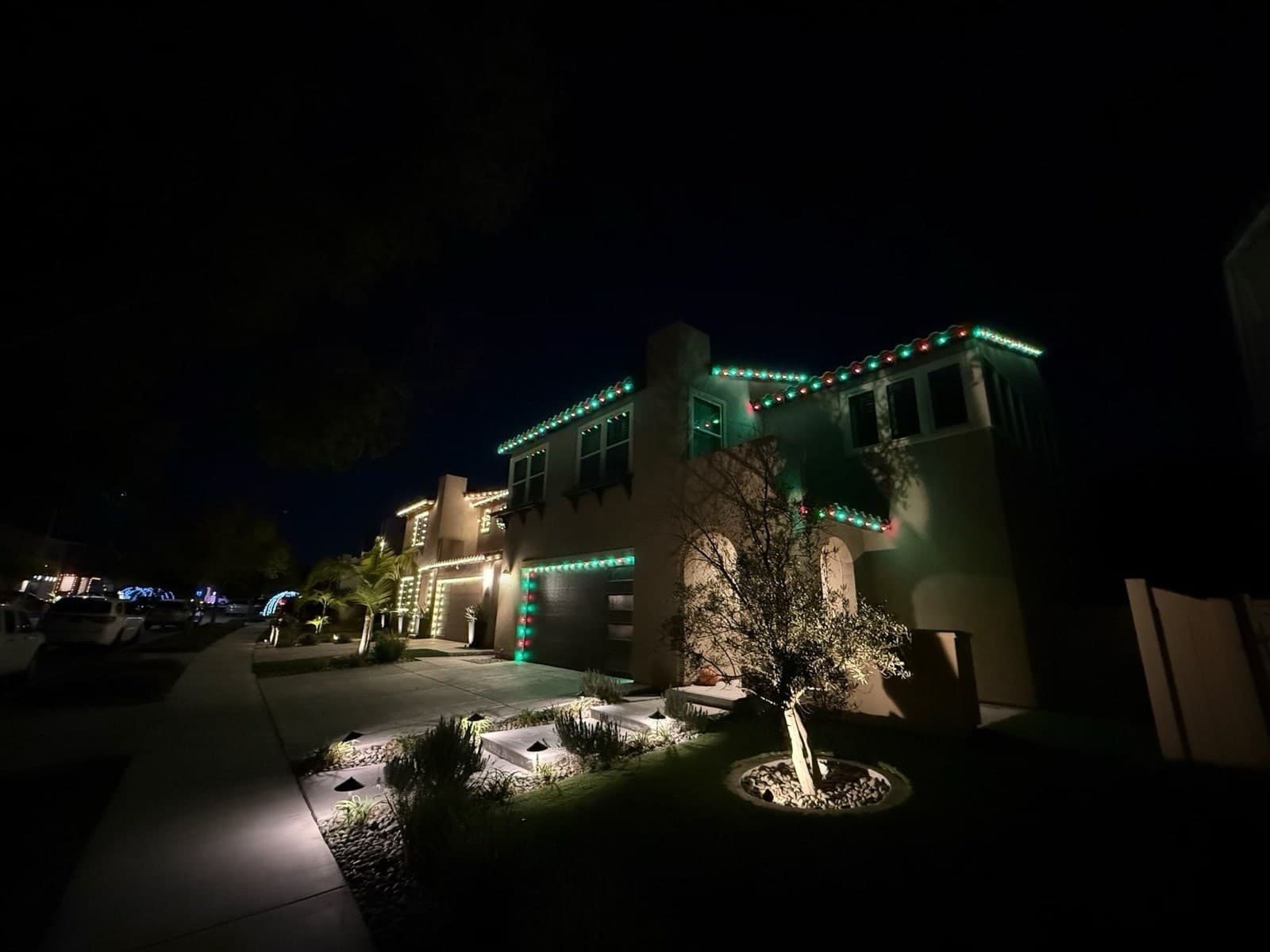
Christmas lights on a tile roof should never touch the field of the roof. They go on the edge: the gutter if you have one, the fascia board behind it, or the lip of the first row of tile. Clips hold them there. Nothing gets stapled, glued, or drilled.
That's how we hang them: clips that grab the tile lip or the fascia, instead of anything driven into the roof.
If your house is one story and you're steady on a ladder, you can do the same thing yourself, and this post will help. If it's two stories of tile, read the next section before you buy anything.
Why Tile Is Different
A shingle roof forgives a lot, and the light clips sold in most hardware stores are shaped for a shingle tab or a gutter.
Tile forgives nothing. Clay and concrete tile will shed water for decades, but each piece is brittle and there's open space under most of it. Force it, lean a ladder on it wrong, or pry at it and it snaps. Clay cracks easily, and old clay is worse.
Height is the other half. Most two-story gables peak well above a homeowner's ladder, and the top of a too-short ladder with a strand in one hand is where people get hurt.
If you've looked up at that eave and decided against it, that's good judgment, not giving up. Two-story rooflines and tile gables are most of what we hang in Carmel Valley.
How the Lights Hold With Nothing Driven In
Almost everything the street sees on a lit house is an edge: the eaves along the front and the gable edges above them. All of it sits on an edge, and none of it needs anything fastened into the roof.
- If there's a gutter, the clip goes on the gutter edge and the tile is never involved.
- If there's no gutter, the clip grabs the fascia board or the lip of the first row of tile. It holds by grip. Nothing goes through anything.
- Every strand is cut to your roofline before install day, so nothing gets stretched or forced to make a corner.
- If a section can't be reached safely, we say so up front and design around it.
S-Tile vs. Flat Tile
Most tile roofs in San Diego are one of two shapes. S-tile is the wavy Spanish profile, a row of humps and valleys. Flat tile lies like thick slate with a squared front edge.
They don't take the same clip. A clip made for a flat edge sits crooked on a curve, and a clip made for a curve has nothing to hold on a flat edge. A clip that doesn't fit either hangs loose, so the bulbs point every direction, or it has to be forced. Forcing anything onto tile is how edges chip. We use clips fitted to the tile profile, S-tile or flat.
The older two-piece clay barrel tile on Spanish revival houses is the most fragile of all. On a roof like that, the gutter or the fascia is a better home for a clip than the tile is.
The shape changes the design too. A red tile roof with deep eaves needs different spacing than a flat-fascia bungalow. And warm white along a red clay eave makes the tile glow.
What About the Stucco?
Most tile roofs here sit on stucco walls, and stucco gives you nothing to clip to. That's why people reach for the two worst options.
Adhesive clips and tape hold through October, then let go in the first warm week, usually with a strip of paint attached. Screws and anchors hold fine, but every one is a hole in the wall, and a hole in stucco is a way in for water.
We never staple, never tape, and never drill. So on a stucco house the lights go on the roofline and stay off the wall. If a stretch is too fragile to clip, we route the run somewhere else and tell you why.
What a Cracked Tile Costs You Later
A cracked tile doesn't leak the day it cracks. That's the trap.
The tile isn't the waterproofing. It's the armor over it. Under the tile is a layer of underlayment that actually keeps water out, and the tile's job is to keep sun and rain off that layer. Crack a tile in November and nothing happens, because it's dry. Then the winter rain finds the gap.
A cracked tile is a leak the following February, and the homeowner is the one who finds out. By then the lights have been down for weeks, and nobody connects the stain on the ceiling to the lights.
The fix is a roofer's job, and matching the shape and color of an older tile isn't always easy. However that bill comes out, it's a bad trade for a string of lights.
What to Ask Any Installer
Whether you hire us or somebody else, four questions sort out who should be anywhere near a tile roof.
What holds the lights on? Clips, fitted to your tile profile. If you hear staples, nails, glue, or screws, keep calling.
What happens to a section you can't reach safely? A good installer tells you before install day and designs around it. A bad one finds out on install day.
Are you insured, and can I see the certificate? We're fully insured, and we're happy to send a certificate of insurance before we set foot on your property. Our crew is covered while they work, so an accident is our problem and never yours.
Who takes them down, and how? Takedown is a second trip to the same fragile edge, and yanking strands from the ground pulls on everything they're clipped to. Ours is included. We come back in January and carefully remove every strand and clip, and the clips don't leave a mark. If a section loosens or goes dark before then, you text us and we come out. That's included too, so you're never the one going up to look.
What It Costs
First-story C9 roofline is $8 a linear foot and second-story roofline is $10, because working a second story is slower and takes more equipment. There's an $800 minimum, and most homes land at $1,200 to $2,400 all-in once you add a tree or some garland.
That price covers the lights, the clips, the timer, repairs all season, January takedown, and storage. The lights are ours, so there's no separate bill for them.
See It on Your House First
Here's the next step, and it doesn't involve a ladder. Text one daylight photo of the front of your house to (858) 315-1247. We send the same photo back with the lights on and the price beside it, usually the same day.
The Design Preview is free, and nothing is due until you like what you see. Torn between warm white and multicolor? Say so when you send the photo. We'll mock up as many Christmas color options as you want on the same photo.
And if you've already stood at the bottom of the ladder this year and thought better of it, that's as good a reason as any to send the photo.
Keep reading
- Our holiday lighting service
- See your own house lit up, free
- Full pricing and packages
- HOA Rules for Christmas Lights in San Diego: How to Light Your House Without a Violation Letter
- Permanent Christmas Lights vs. a Yearly Install in San Diego: The Three-Year Math
- Warm White or Multicolor? How to Pick Christmas Light Colors for a Stucco House
- How Much Does Christmas Light Installation Cost in San Diego? (2026 Prices)
- When to Book Christmas Light Installation in San Diego
- The Best Christmas Lights for Coastal San Diego Homes
Areas we serve