|8 min read
The Short Answer
Most San Diego homes light up the weekend after Thanksgiving. A growing share come on the week before, so the house is already lit when the guests pull in. And the first homes on any street go up in the middle of November, usually the ones whose owners booked back in September.
That's what we see on our coastal route, La Jolla to Coronado to Carmel Valley, season after season. It isn't a survey and we're not going to pretend it is. It's the calendar we drive.
The rest of this guide is the why, and the part most people get wrong: the day the lights go up and the night they come on don't have to be the same day. Once you separate those two, the timing question mostly answers itself.
Free Design Preview
See your home lit up before you pay anything
Text us one photo of your house and we’ll send back a real mock-up with the lights on, usually the same day, with the price beside it. No salesperson, and no house call unless you want one.
Why San Diego Runs Later Than Cold-Weather Places
In Denver or Minneapolis, installers are hanging lights in early October and nobody blinks. There's a deadline up there. The first hard freeze or the first snow ends the hanging season, so the lights go up while they still can, and the weather already looks like the holidays.
San Diego has no such deadline. October here is 78 degrees and sunny, the pumpkins are still on the porch, and a lit roofline next to a jack-o'-lantern looks like someone lost track of the month. Almost nobody wants their house lit in October, and most people don't want it lit in the first week of November either.
The one piece of weather that matters is the Santa Anas. Late October and November are when the hot, dry wind comes through, sometimes at 40 miles an hour. That's a wind test for a display, not a reason to wait. A display on clips sized to the roofline rides it out, and one that's stapled or taped does not. We wrote about that in our guide to lights for coastal homes.
So the whole season compresses. Nobody wants lights in October, everybody wants them by Thanksgiving, and the install window lands in about three weeks of November. That's the squeeze, and it's the reason the next section exists.
Why Installers Book Earlier Than Homes Light Up
If you're asking when to book rather than when to light up, the answer is earlier than any date in this guide, and our guide on when to book covers it in full. The short version: the ten days before Thanksgiving and the weekend after it always go first, and returning customers and September and October bookers claim a good share of that calendar before the season even starts, often before they've settled on a design.
There's a second reason the calendar runs ahead of the lights. Every strand we hang is cut to your house before install day, socket by socket, and that takes real time. A September booking means we're cutting your strands in October with room to breathe. A mid-November booking means we're cutting them the night before, if there's a night left. Our prices are on the pricing page.
Two Calendars: When the Lights Go Up and When They Come On
Here's the fact that solves most of the timing worry. The day the lights go up and the night they come on are two different dates, and only one of them is visible from the street.
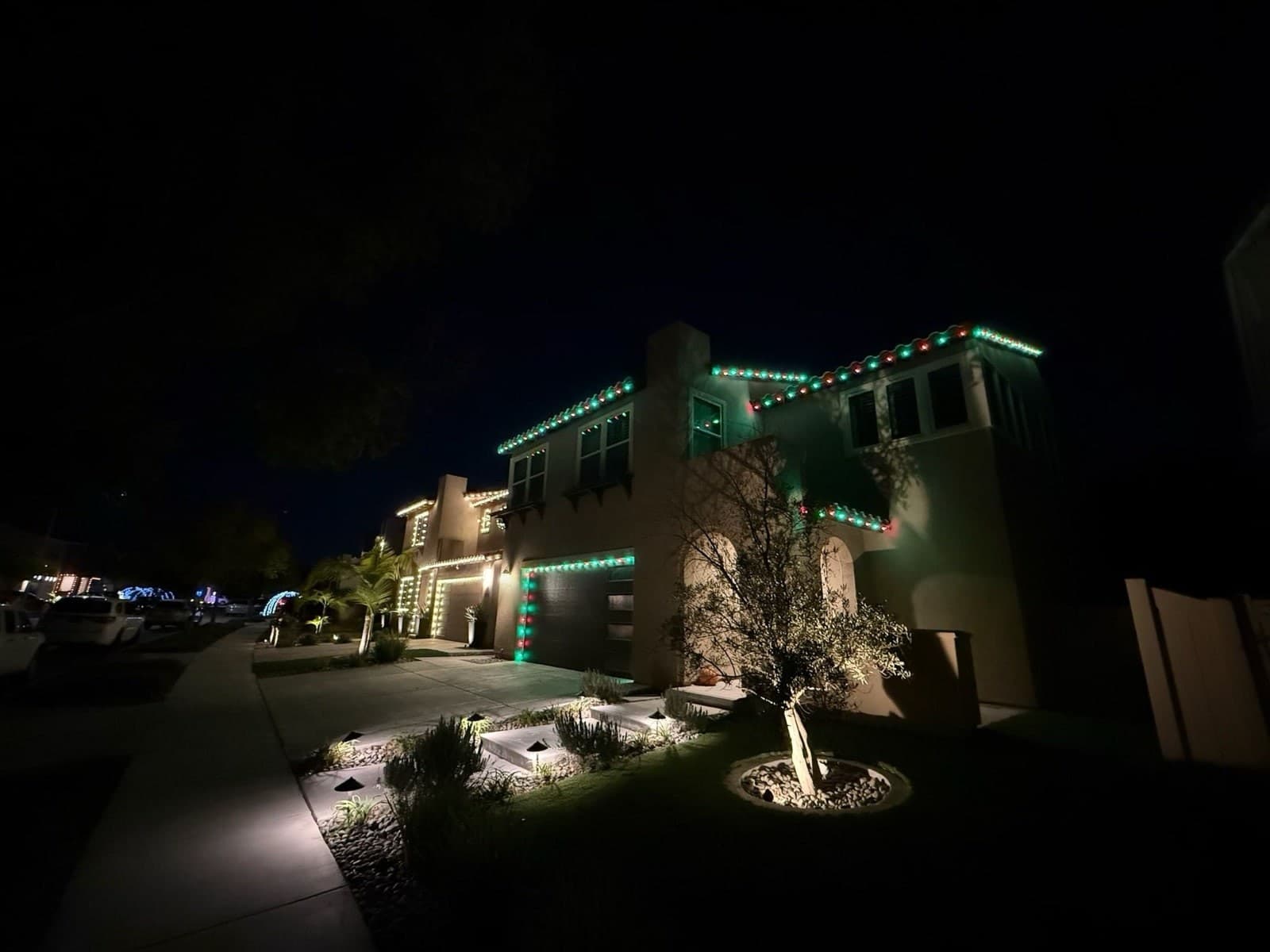
Every display we install runs on a smart timer. It comes on at dusk and shuts off on your schedule, and we set it to whatever you tell us. That means a display can go up in the second week of November and stay dark until the night you choose. The neighbors see our truck for a day and then nothing, until the night it comes on and the house is finished.
That's how early installs work without looking early. It's also why the homes with the best install dates are rarely the first ones lit on the block. They went up early and came on when the family wanted them on.
So the install date is ours to solve and the lit date is yours to pick. Tell us the night, and we schedule backward from it.
How to Pick Your Lit Date
Start from the night, not the day. Whichever one you pick, the install lands before it, sometimes well before it, and the display stays dark until then. If you change your mind about the night, the timer moves by text and nothing about the install has to change. Here are the four nights people pick most, and all four work.
- The first night of guests. If family lands the Wednesday before Thanksgiving, that's the night. The house is lit when they pull up, and nobody spends the holiday on a ladder.
- Thanksgiving evening. Lit as the dishes get cleared, so the first walk around the block has something to see. It's the most requested night of the year, and the one we build the November schedule around.
- Your street's night. Some blocks light up together. In Coronado we set timers so a block comes on the same evening, and plenty of other streets have an unofficial first weekend. If yours does, tell us and your timer matches it.
- The first Saturday in December. If Thanksgiving feels early to you, this is the other classic. The install still happens in November, and the display waits in the dark until your night.
What Goes Up, and in What Order
Roofline, then trees, then the entry. That's the order the street reads a house in, so it's the order we design in and the order to spend in.
The roofline is what the street actually sees. It's the part that reads from a block away, and on most homes it's where the first dollars go. Trees are what make it feel warm when someone pulls into the driveway: wrapped palms down the drive, a mature branch tree lit through its structure. The entry is the last layer and the one guests see up close. A wreath over the door, garland on the porch rail, lit columns on either side.
Most homes go up in a day. A full property with trees, garland, and pathway lighting can run longer, and we tell you before we start. Either way, every strand was cut to your house before install day, so install day is hanging what already fits, not measuring.
If you're designing to a number, that order is also the order to trim from the bottom. A common move is the full roofline in year one and the trees in year two. Both are good. One of them can wait a season.
When They Come Down
The first two weeks of January, for most homes. The tree goes out, the house goes back to normal, and the lights follow. Some associations set a date, and in Carmel Valley and Rancho Santa Fe we plan the takedown around it from the start.
Takedown is included. We come back on your scheduled date, take down every strand and clip, inspect each bulb, and store the display labeled to your address until next November. The clips come off without leaving a mark, and nothing goes in your garage.
Takedown dates fill the same way install dates do, so the people who booked early get first pick of those too. And next year starts with a phone call instead of a project. The display already fits your house, and years two and three run 10% off your year one price.
If You're Reading This in Late November or December
Call anyway. Cancellations happen and schedules shift, and we'll tell you straight what's left rather than take a deposit and squeeze you in after dark on a weeknight in mid-December. A rushed install is worse than no install, and it's your house either way.
Be realistic about the size, though. A smaller display booked late is far more likely to happen than a full one. A clean roofline goes up fast. Roofline plus six wrapped trees and a 60 inch wreath does not, and we won't promise the whole thing and deliver two thirds of it. Our install window runs through early December, and the later in it you call, the more likely the honest answer is roofline only.
If this season can't happen, get your Design Preview done now for next year. You'll be at the front of the line when booking opens, we'll already have your design, and your strands will be cut before the rush starts. Most homes land at $1,500 to $3,000 all-in, and the full rate sheet is on our pricing page, so you'll know the number before you decide anything.
See It Lit Before You Pick the Night
The Design Preview is where this starts, and it doesn't need a ladder or a house call. Text one daylight photo of the front of your house to (858) 315-1247. We send the same photo back with the lights on and the price beside it, usually the same day, and nothing is due until you like what you see.
Then tell us the night you want it lit. A 10% deposit holds your install date, we build the schedule backward from your night, and the timer does the rest.
Whether you're reading this in August or the week before Thanksgiving, the first step is the same photo.
Keep reading
- Our holiday lighting service
- See your own house lit up, free
- Full pricing and packages
- HOA Rules for Christmas Lights in San Diego: How to Light Your House Without a Violation Letter
- Permanent Christmas Lights vs. a Yearly Install in San Diego: The Three-Year Math
- Christmas Lights on a Tile Roof: How We Hang Them Without Cracking a Tile
- Warm White or Multicolor? How to Pick Christmas Light Colors for a Stucco House
- How Much Does Christmas Light Installation Cost in San Diego? (2026 Prices)
- When to Book Christmas Light Installation in San Diego
- The Best Christmas Lights for Coastal San Diego Homes
Areas we serve